

Cyber Crime Prevention in Jammu & Kashmir: Policy, Infrastructure, and Operational Frameworks
1. Introduction and The Unique Cyber Landscape of J&K
The Union Territory of Jammu and Kashmir (J&K) has a complex internal security and digital law enforcement situation. Over the past decade, the rapid growth of internet access has shifted quickly from long-term security-related connectivity limitations to widespread high-speed 4G and 5G mobile networks. This change has greatly increased the region’s digital presence.
While digitization has improved governance and banking through the “Digital India” and “Digital J&K” initiatives, it has also widened the opportunities for cyber criminals. In J&K, cyber threats fall into two main categories:
-Conventional Cyber Frauds:These include financially motivated crimes like UPI scams, identity theft, phishing, and “Digital Arrest” extortion schemes.
-State-Threat Cyber Warfare: This involves cross-border cyber threats, including radicalization, misinformation campaigns aimed at disturbing public order, and hacktivism targeting vital local infrastructure.
2.Typology of Prevalent Cyber Threats in the Region
The J&K Police Cyber Crimes Investigation Centre (CICE) and local district cyber cells identify the most common threats in clearly defined high-risk and medium-risk groups.
High-Risk Threats
– Digital Arrest Scams: This is a sophisticated form of online financial extortion that is growing quickly. Fraudsters impersonate central law enforcement agencies (like NCB, CBI, Customs, or State Police) and contact victims via video calls (Skype/WhatsApp). They falsely claim that a package containing contraband has been intercepted in the victim’s name, forcing individuals into unauthorized and immediate bank transfers.
-OTP & UPI Payment Fraud: This involves tricking victims into revealing One-Time Passwords (OTPs) or scanning fake QR codes under the pretense of receiving payments, which instead quickly drains their accounts.
– Online Financial Extortion (Sextortion & Loan App Scams): This uses predatory instant loan apps that take contacts from the victim’s smartphone and later blackmail them with altered images.
-Misinformation and Disinformation Overdrive: This refers to the spread of unverified and inflammatory text, video, or deepfake audio over WhatsApp, Telegram, and X (formerly Twitter) with the aim of creating civil unrest or public panic.
Medium-to-Low Risk Threats
-Fake KYC Updates:These target vulnerable groups, particularly older citizens and rural residents, with bogus SMS alerts claiming that their BSNL SIM cards or bank accounts will be deactivated unless they urgently install remote access apps (like AnyDesk, TeamViewer).
-Tourism Industry Spoofing:This involves creating fake look-alike websites that mimic official resources (like jktourism.org) or known houseboat operators to steal booking amounts from unsuspecting tourists visiting places like Srinagar, Gulmarg, or Pahalgam.
3. Institutional and Legal Safeguards
To effectively counter these evolving threats, J&K depends on a unified legal and organizational structure that combines central Indian laws with specialized local administrative teams.
Statutory Framework
Enforcement is mainly governed by the Information Technology (IT) Act, 2000, with a focus on:
-Section 66C:Punishment for Identity Theft.
-Section 66D: Punishment for Cheating by Personation using Computer Resources.
-Section 67A:Strict liability concerning sexually explicit digital material.
These laws work in conjunction with relevant provisions of the Bharatiya Nyaya Sanhita (BNS) concerning criminal conspiracy, cheating, and extortion.
Institutional Ecosystem
-The J&K CICE: This is the primary agency for deep-tech investigations, cross-border tracking, and managing complex cyber forensic data.
-District Cyber Cells:These operate in major districts (like Srinagar, Jammu, Budgam, and Anantnag) to register local First Information Reports (FIRs), disrupt immediate fraud chains, and manage the 1930 National Cybercrime Helpline desk at the local level.
-Inter-Departmental Oversight:A high-level administrative team led by the Chief Secretary of J&K ensures strict compliance and tracks progress through the state Pragati Portal. This establishes clear accountability among the Home Department, IT Department, Law Department, and Police Operations.
4. Current Strategic Initiatives (2026 Focus)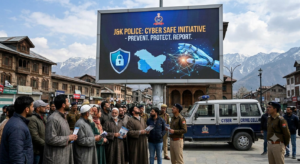
The government of J&K has changed its approach from reacting to crimes after they occur to taking proactive measures to prevent them.
The Digital Arrest Prevention Mechanism
Begun in mid-2026, this initiative creates real-time containment loops for digital extortion. It coordinates immediate financial transaction freezes with national banking networks as soon as a “Digital Arrest” contact is reported, cutting off the channels used by cyber criminals to cash out before the money can be laundered.
The Suspect Repository & Identifier Screening
J&K connects directly with the Indian Cyber Crime Coordination Centre’s (I4C) central database. This allows local police to check and submit identified suspects, including WhatsApp numbers, Telegram IDs, bank account numbers, suspicious URLs, and SMS headers, into a national database readily accessible by security forces across the country.
5. Challenges in Cyber Enforcement Specific to J&K
Preventative measures face unique challenges in this Union Territory:
-Asymmetric Border Threats:The persistent use of encrypted Virtual Private Networks (VPNs), proxy servers, and dark web communication by criminals in foreign locations complicates traditional tracking efforts.
– Rapid Digital Adoption vs. Digital Literacy Gaps: While mobile commerce has reached remote areas, basic awareness of cybersecurity—like recognizing phishing links or understanding QR codes—is still lacking.
– Forensic Backlogs & Capacity Building:The surge in data volume means local police need constant training. Officers require ongoing skill development in open-source intelligence (OSINT), blockchain analysis, and mobile device forensics to keep up with modern crime trends.
6. Comprehensive Prevention Guidelines: A Public Manual
To strengthen local cyber resilience, the government outlines essential preventative steps all citizens, tourists, and businesses should follow.
Digital Safety Protocol
– Multi-Factor Authentication (MFA): Activate 2-Step Verification on email accounts, social media profiles, and communication platforms like WhatsApp.
– Verification Rule: Never install remote access applications (like AnyDesk, TeamViewer) at the request of incoming callers, regardless of their stated position.
– Password Management: Use strong, non-repeating passwords of at least 12 mixed alphanumeric characters, and change them every three months.
7. Immediate Crisis Mitigation Framework
If someone becomes a victim of a cyber financial crime in J&K, immediate action within the first “Golden Hour” greatly improves the chances of recovering lost funds.
1.Dial the 1930 National Cybercrime Helpline:
Call within 60 minutes. Have your bank account details, transaction reference numbers, timestamps, and mobile numbers ready to share.
2. File a Formal Complaint on the National Portal:
Do this within 2 hours. Go to cybercrime.gov.in and fill out an accurate digital complaint. Upload screenshots of chats, transaction alerts, or fraudulent numbers.
3. Contact Bank Nodal Officers:
Notify the fraud control desk of your bank or digital wallet provider to freeze the outbound transaction route.
4. **Preserve Electronic Evidence:
Keep unedited call logs, messages, and transaction receipts without changing any metadata. Do not delete chat histories, as they serve as vital court-admissible evidence.
8. Conclusion and Future Directions
Cyber crime prevention in Jammu and Kashmir is evolving from being solely a police duty to a more complete, institutional effort. True digital resilience in the region depends on three key areas: strong administrative support, quick technical skill development for law enforcement, and an informed public. By consolidating local response teams, tightening regulation of online identifiers, and launching extensive safety campaigns, J&K is gradually creating a reliable digital framework to safeguard its economy and citizens from modern online threats.


One thought on “Cyber CRIME prevention in Jammu and kashmir JULY 6”