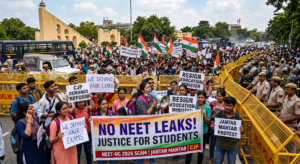
The 2026 Cockroach Janta Party (CJP) protests at Delhi’s Jantar Mantar and in major Indian cities began as a satirical movement and evolved into a large student-led demonstration.
Overview: The Origin & Trigger
The movement started in May 2026 after comments made during a court hearing about student activism and high unemployment. In response, political communications graduate Abhijeet Dipke launched the “Cockroach Janta Party” (CJP) on social media as a way to express satire.
By June 2026, the movement shifted from online satire to real-life demonstrations, fueled by student frustration over issues in national competitive exams. This included allegations of a NEET-UG 2026 paper leak and discrepancies in CBSE Class 12 board results.
Key Demands & Movement Growth
What began as an online campaign turned into protests in cities like New Delhi, Pune, Bengaluru, and Lucknow.
Core Demands
– Ministerial Accountability: Resignation of Union Education Minister Dharmendra Pradhan due to alleged problems with exams and recruitment.
– Systemic Exam Reforms: A complete overhaul of testing agencies, clear re-examinations, and stricter actions against paper leaks.
– Broad Civil Demands: Protection of educational opportunities, addressing graduate unemployment, and civil rights issues.
Protests, Allegations, and Security Interventions
Security & Law Enforcement Response
As the protests grew near government buildings, law enforcement put strict security measures in place:
– Prohibitory Orders: Section 163 of the Bharatiya Nagarik Suraksha Sanhita (BNSS) was enforced in central New Delhi.
– Transit & Access Restrictions: Several metro stations near Parliament were temporarily closed to control crowd sizes.
– Clashes & Dispersal: Police set up barricades, used tear gas, and baton charges near Constitution Club when protesters tried to enter restricted areas toward Parliament.
Claims vs. Counter-Claims
Government & Law Enforcement: Authorities said public safety, traffic disruptions, lack of permissions for the Parliament march, and risks from outside political groups justified the strict measures.
CJP & Student Organizers: Organizers argued that the movement was a peaceful protest protected by the Constitution. Participants were told to carry the national flag (Tiranga), books, or photos of figures like B.R. Ambedkar to show their non-violent intent.
Impact
The CJP NEET protests showed deep frustrations with educational management, testing integrity, and youth unemployment in India. They demonstrated how online satirical movements can quickly lead to real-world political mobilization.
Official Government Accusations & Rhetoric
Political Remarks: Union Education Minister Dharmendra Pradhan ignited significant political tension by dismissing CJP organizers and radical factions as a “B-team of anti-national elements.” In some comments, he referred to them as a “B-team of terrorists.” The government claimed that political opposition groups had hijacked a student issue to disrupt public order and undermine national testing bodies.
Intelligence Bureau (IB) Blocking Orders: On June 21, 2026, the CJP’s main official account on X (formerly Twitter) was blocked in India based on Intelligence Bureau input. Sources indicated that the content had the potential to “cause widespread public chaos” and threaten national order concerning re-examinations. (Note: The Delhi High Court later unblocked the account on July 7, 2026, ruling that the government’s reasons were no longer valid).
2. Allegations of Illegal Actions & Violence (The July 20 Parliament March)
While “anti-national” is not a recognized legal term in Indian criminal law, Delhi Police filed multiple First Information Reports (FIRs) under the Bharatiya Nyaya Sanhita (BNS) for serious public disorder violations following the “Chalo Sansad” march on July 20, 2026:
– Unauthorized Drone Operations: An FIR was filed for flying unauthorized surveillance drones over high-security areas near Parliament House during the Monsoon Session.
– Rioting & Assault on Law Enforcement: Delhi Police reported unlawful assembly, stone-throwing, and violent clashes that injured over 118 security personnel, including senior officers.
– Vandalism of Public & Government Property: Protesters were accused of breaking through security barricades, damaging police vehicles, and trying to breach restricted government areas near Connaught Place and Parliament.
– Conspiracy to Incite Violence: Legal action was taken against unidentified individuals and fringe student union leaders for allegedly escalating the situation from a peaceful sit-in to violent confrontations.
3. The Counter-Perspective & Defense by Organizers
Use of National Symbols: CJP founder Abhijeet Dipke and well-known figures like environmental activist Sonam Wangchuk repeatedly urged participants to carry the Indian National Flag (Tiranga), copies of the Indian Constitution, and photos of B.R. Ambedkar during marches to emphasize their peaceful, constitutional stance.
Rejection of the “Anti-National” Label: Public figures and supporters—including artist Diljit Dosanjh and activist Sonam Wangchuk—strongly criticized authorities for calling youth demanding accountability in education “anti-national” just for exercising their rights to protest. Organizers argued that fighting against exam corruption and paper leaks was a patriotic effort to improve the nation’s education system.