The Government of India’s decision to impose wide-ranging, unprecedented temporary restrictions on Telegram in June 2026 has created a stir in the global digital landscape. This action, driven by urgent concerns related to public order, national security, and fraud issues surrounding the National Eligibility-cum-Entrance Test (NEET-UG) 2026 re-examination, led the Ministry of Electronics and Information Technology (MeitY) to implement a complex intervention.
This measure includes a complete platform-access block across major telecommunications networks and a contentious requirement to disable message editing for all users. This response offers a detailed look at the June 2026 Telegram restrictions. It covers the context of the paper leak crisis, the legal framework for the ban, the technical details of the restrictions, the socio-economic impacts on India’s 150 million users, the platform’s counterarguments, and the broader geopolitical consequences.
1. The Trigger: The 2026 Examination Crisis & Cheating Rackets
India’s competitive examination system faced a major crisis in mid-2026. After uncovering widespread question paper leaks, public protests erupted, prompting the Ministry of Education to cancel the initial undergraduate medical entrance exam (NEET-UG). A nationwide re-examination was set for June 21, 2026.
To maintain the integrity of the re-test, law enforcement agencies and the National Testing Agency (NTA) initiated a thorough monitoring campaign focused on digital channels exploited by dishonest actors.
The Methods of Examination Fraud
Information gathered by the Indian Cyber Crime Coordination Centre (I4C), under the Ministry of Home Affairs, and state police departments in Bihar, Gujarat, and Rajasthan, pinpointed Telegram as the main platform for organized cheating networks. These groups utilized public and private channels, heavily automated bots, and large chat groups with names like “PAPER LEAKED NEET,” “Re-NEET 2026,” and “Private Mafia.”
These dishonest actors took advantage of Telegram’s design to carry out two main types of cyber fraud:
Financial Fraud through Fake Paper Sales: These networks aggressively promoted access to upcoming re-examination papers. Desperate candidates and their families were pressured into transferring amounts ranging from a few thousand to several lakhs into fraudulent bank accounts. During one crackdown, the Ahmedabad City Cyber Crime Branch arrested members of an inter-state syndicate running eight different Telegram channels that funneled over ₹1.5 crore through mule accounts.
Retrospective Evidence Fabrication: A more deceptive tactic involved using Telegram’s message-editing feature. Syndicates would post harmless text messages or blank PDF files weeks before an exam. When the actual test began or ended, they would edit the original files to replace them with the real question paper. Since Telegram keeps the original sending timestamp instead of updating it, these scammers created fake “proof” that they had the leaked paper before the exam. This material was then used to undermine public trust, extort money, and influence the post-exam situation.
The Limitations of Traditional Moderation
Before suggesting a full platform restriction, the NTA and I4C attempted targeted takedowns. While numerous channels, groups, and automated bots were disabled, new ones appeared within hours. The decentralized, rapidly changing nature of Telegram, along with its history of resisting real-time enforcement tools for state agencies, made localized content moderation ineffective.
Seeing the situation as a serious threat to public order and the futures of many students, the NTA recommended that MeitY implement a platform-level intervention as a last resort.
2. Legal Framework: Section 69A & Feature Redesign Orders
Order 1: The Platform Access Restriction
On June 16, 2026, MeitY issued an emergency blocking order under Section 69A of the Information Technology Act, 2000, in conjunction with the Information Technology (Procedure and Safeguards for Blocking for Access of Information by Public) Rules, 2009. This law lets the Central Government direct any intermediary to block access to online information if necessary for the:
– Sovereignty and integrity of India
– Defense of India
– Security of the State
– Friendly relations with foreign countries
– Public order
– Preventing incitement to crimes related to the above
The government justified the block as a means to maintain public order and prevent large-scale fraud that could disrupt the education system. This order is temporary, set to expire on June 22, 2026—the day after the re-examination.
Order 2: The Feature-Specific Redesign Mandate
In an unusual regulatory step, MeitY issued a separate directive ordering Telegram to disable its message-editing feature for existing content within India’s borders. This restriction will last until June 30, 2026. The purpose is to lock the platform’s historical data during the period following the exam, ensuring no new retrospective “paper leaks” can occur while law enforcement addresses post-exam complaints.
The Digital Rights Debate
These orders have raised concerns among legal experts and digital rights groups like the Internet Freedom Foundation (IFF). The main legal question is whether Section 69A gives the government the authority to require product design changes.
Critics argue that while Section 69A allows for the targeted blocking of specific URLs, accounts, or items of information, it does not explicitly permit altering the product features of an intermediary for an entire country. Legal challenges suggest that requiring a platform to disable a key feature like message editing exceeds the limits set by the 2009 Blocking Rules.
3. Technical Execution & Platform Enforcement
Implementing a nationwide digital restriction on a platform with over 150 million active users requires coordinated action across three layers of India’s internet infrastructure: the application layer, the network layer, and the platform architecture layer.
Application Store Takedowns
After the MeitY directive, the government promptly ordered Google LLC and Apple Inc. to remove Telegram from the Indian Google Play Store and Apple App Store. This immediate removal stops new users from downloading the app and prevents existing users from receiving official software updates during the restriction period.
Network-Level Blocking (ISPs and Telcos)
To limit access for current users, major Indian telecom providers, including Reliance Jio, Bharti Airtel, and Vodafone Idea, along with major Internet Service Providers (ISPs), changed their network configuration files. These blocks are executed mainly through two methods:
– DNS Resolution Blocking: ISP DNS servers are set to drop or redirect queries for Telegram’s main domains (like telegram.org and t.me), preventing the app from connecting to Telegram’s data centers.
– IP and SNI Filtering: For stricter enforcement, deep packet inspection (DPI) and firewall rules filter traffic aimed at Telegram’s known IP address blocks or search for Server Name Indication (SNI) headers that match Telegram traffic during the TLS handshake, systematically blocking those connections.
Technical Complications: BGP Routes and Global Disruptions
Implementing the network block resulted in unintended issues. Telegram CEO Pavel Durov reported that some networks linked to Indian telecoms unintentionally leaked or miscommunicated network changes to global internet providers.
Since Telegram routes global traffic dynamically, these misconfigurations briefly affected access to Telegram servers in several neighboring countries. This situation highlights the difficulties of trying to isolate a large global communication platform within specific geographic borders.
4. Platform Response: Pavel Durov’s Critique & Countermeasures
The platform’s leadership reacted strongly to the government’s actions, questioning both the effectiveness and the rationale behind the ban.
The “Punishment” of Ordinary Users
Pavel Durov made a public statement through his personal channel and on X (formerly Twitter), describing the Indian government’s measures as an overreach that punishes a vast innocent population. Durov argued:
“India’s IT ministry banned Telegram for one week because some users shared leaked exam questions. This punishes over 150 million ordinary Telegram users in India, not those responsible for leaking the exam materials. And the ban hasn’t stopped anything. The leaks just moved to other apps.”
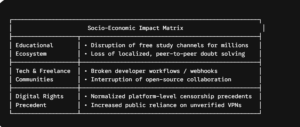
Durov’s main point is that broad app bans are imprecise. By disabling a platform used by 150 million people for legitimate business, education, personal safety, and messaging, the state causes significant disruption without fixing the systemic issues that led to the physical examination papers being leaked.
Telegram’s Enhanced Moderation Efforts
In defense of its security measures, Telegram shared data showing its recent anti-fraud actions within the Indian market. The platform claimed that its internal moderation metrics meet or exceed industry standards.
To address exam-related scams, Telegram used customized AI-driven classification tools to scan public channels, groups, and bot listings for keywords tied to Indian competitive exams. According to updates from the platform:
In 2025, Telegram blocked over 43.5 million channels and groups worldwide for breaking rules.
By June 2026, daily content removals surged, increasing from an average of 10,000–30,000 to between 80,000 and 140,000 daily removals.
The Future of Digital Platforms in India
The temporary restriction of Telegram in June 2026 serves as a case study in the ongoing struggle between state sovereignty and decentralized, cross-border digital platforms. The trigger organized syndicates utilizing Telegram’s cloud features to exploit students and fabricate evidence revealed real vulnerabilities in traditional content moderation. At the same time, the state’s response a full platform block showed how state interventions can inadvertently disrupt millions of legitimate users, student networks, and digital enterprises.
As the restrictions lift and regular service resumes, the long-term relationship between India and Telegram will require structural evolution. Platforms can no longer rely on claims of algorithmic neutrality or absolute non-cooperation when faced with systemic criminal activity that threatens national security or public order. Conversely, states must recognize that in an interconnected economy, shutting down an entire communication network can cause widespread collateral damage.
The legacy of the June 2026 ban will likely center on the policy framework it leaves behind: a clear message that compliance, structural transparency, and proactive fraud prevention are now mandatory requirements for any digital platform looking to operate in India.