
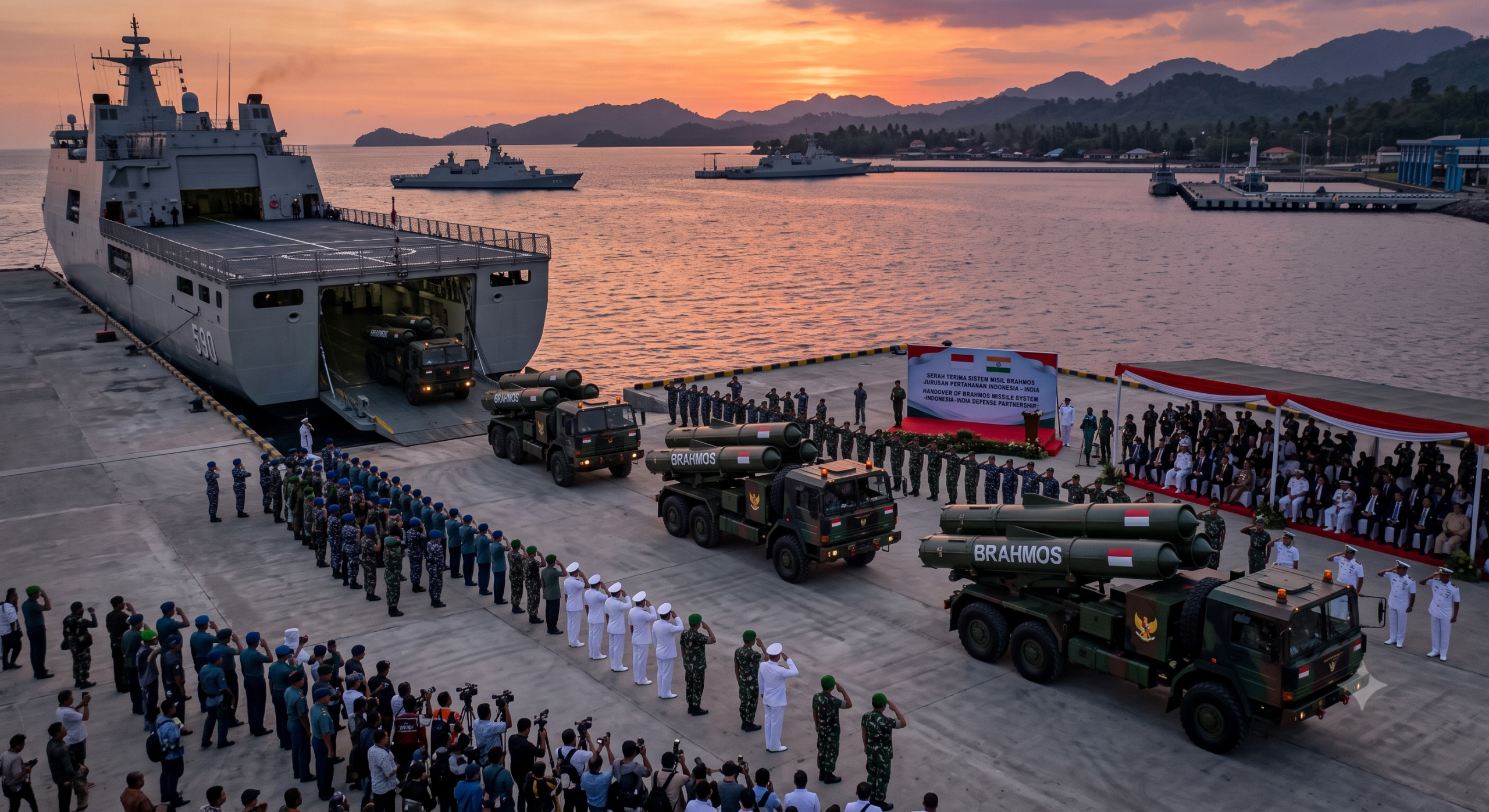
BrahMos supersonic cruise missile system and the Astra Beyond Visual Range (BVR) air-to-air missile. This agreement marks a significant geopolitical shift, making Indonesia the third Southeast Asian nation to acquire the BrahMos, following the Philippines and Vietnam. It creates what defense analysts describe as a “strategic supersonic belt” across key Indo-Pacific choke points.
1. The Core Components of the Agreement:BrahMos
The defense package represents a dual-domain modernization effort for the Indonesian National Armed Forces (TNI). It focuses on both maritime denial and aerial superiority.
BrahMos Supersonic Cruise Missile
Indonesia will acquire two batteries of the land-based coastal defense variant of the BrahMos missile. The package is valued at about $200 million.
The Battery Structure: BrahMos coastal defense battery includes mobile autonomous launchers (usually 3 to 4 per battery), mobile command posts, radar systems, and support vehicles, carrying multiple ready-to-fire missiles.
BrahMos ,The Phased Approach: The contract sets up a phased acquisition model. Future phases may look at integrating the missile onto the Indonesian Navy’s (TNI-AL) surface combatants.
The Astra Air-to-Air Missile
In a significant secondary development, state-owned Bharat Dynamics Limited (BDL) signed an agreement with Indonesia’s Republikorp to supply the Astra BVR missile. This makes Indonesia the first foreign export customer for India’s air-to-air missile. The Astra will be integrated into the Russian-origin Sukhoi Su-30MK2 and Su-27 fighter jets used by the Indonesian Air Force (TNI-AU). This provides a strong alternative to Western or Russian state-controlled missile stockpiles.
2. Technical Capabilities: Why Indonesia Chose BrahMos
BrahMos, a collaboration between India’s DRDO and Russia’s NPO Mashinostroyeniya, offers unique technical benefits for an archipelago nation:
Kinetic Dominance: With speeds up to Mach 2.8 to 3.0, the BrahMos is about three times faster than standard subsonic cruise missiles, such as the American Harpoon or French Exocet. This high speed greatly reduces an enemy’s ability to react and intercept.
Destructive Impact: The combination of a 200 to 300 kg warhead and the tremendous kinetic energy generated by Mach 3 speed creates a powerful impact. It can neutralize large surface warships with a single strike.
Familiar Pedigree: The TNI-AL previously operated the Russian-made P-800 Yakhont, which is the baseline missile from which the BrahMos was developed, on its Van Speijk-class frigates. Since Indonesian military planners already understand the logistics and operations of this missile family, integrating the BrahMos will have a much shorter learning curve.
3. Geopolitical and Strategic Implications:BrahMos
The finalization of this deal, which took nearly eight years to negotiate, carries significant strategic weight for the Indo-Pacific region.
CONCLUSION
1. Hardening the Archipelagic Sea Lanes (ALKIs)
Indonesia controls some of the most critical maritime choke points in the world, including the Strait of Malacca, the Sunda Strait, and the Lombok Strait. By deploying land-based BrahMos batteries in these areas, Indonesia creates an effective Anti-Access/Area Denial (A2/AD) umbrella. This ensures that Jakarta can monitor and protect its exclusive economic zones (EEZ), especially around the resource-rich Natuna Islands, where Chinese fishing fleets and coast guard vessels often intrude.
2. The Rise of India as a Defense Exporter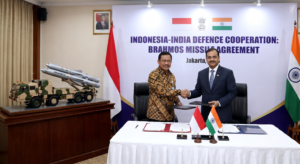
For New Delhi, this $630 million contract is a significant achievement for its Atmanirbhar Bharat (Self-Reliant India) initiative and defense export goals. By establishing a security presence in Southeast Asia’s largest economy, India moves from being a regional security provider to a major defense industrial partner, furthering its “Act East” policy.
3. Preserving Indonesia’s Non-Aligned Balance
By purchasing from India, Indonesia stays true to its Bebas-Aktif (Independent and Active) foreign policy doctrine. This allows it to modernize its military without depending entirely on Western arms or aligning directly with US military frameworks. It strengthens regional deterrence while maintaining an independent strategic stance.
4. Broadened Cooperation Beyond Missiles
The BrahMos deal served as a foundation for 16 bilateral cooperation agreements signed during the July 2026 state visit. These initiatives reinforce the strategic nature of the partnership:
The Sabang Port Project: The two nations revived plans to develop deep-sea port infrastructure at Sabang, located at the northern tip of Sumatra near the entrance to the Malacca Strait.
Critical Minerals & Industry: A joint venture between the Steel Authority of India (SAIL) and PT Krakatau Steel was formed to build a stainless-steel slab facility in Indonesia, utilizing the archipelago’s vast nickel and rare earth resources.
Maritime Domain Awareness: Indonesia will now have a permanent Liaison Officer at India’s Information Fusion Centre–Indian Ocean Region (IFC-IOR) to support real-time tracking of cross-border maritime threats.
This comprehensive agreement positions India and Indonesia as key partners in maritime security in the Indo-Pacific and establishes a strong balance of power across the region’s vital trade routes. This video outlines the broader strategic context of the defense partnership and explains how the missile systems fit into the changing maritime balance of the Indo-Pacific: Indonesia Buys BrahMos & Astra Missiles from India.