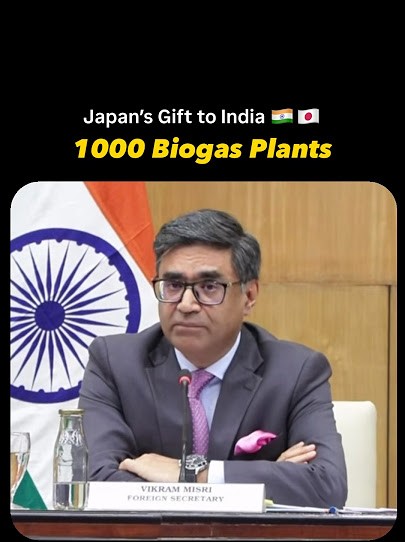
Another noteworthy development in the strengthening of strategic relations between India and Japan is the launch of a massive initiative that envisages setting up 1,000 biogas plants in India until 2030. The initiative was announced during the 16th India-Japan Annual Summit held in New Delhi. It signifies the commitment of India and Japan towards renewable energy, improvement of rural life, lessening dependency on fossil fuels, and environmental concerns. Although the initiative has been labeled as “gift from Japan to India” by several people, it is in fact a joint venture where Japan will offer technological, financial assistance, and expert knowledge to India whereas India will make use of its huge agricultural resources.
An India-Japan Landmark Green Energy Venture

The initiative was jointly announced after talks between Indian Prime Minister Narendra Modi and Japanese Prime Minister Sanae Takaichi. The initiative launched by India and Japan as a part of the deal includes the Japan-India Compressed Biogas (CBG) Initiative that aims at producing compressed biogas (CBG) from the cattle dung, rice straw, sugarcane waste, and other agricultural waste materials.
Need for Biogas Plants in India
India happens to be one of the most important agricultural economies in the world, generating millions of tons of organic waste annually. However, there are plenty of examples where the same organic waste is either burnt off or wasted. Moreover, the use of conventional fuels like wood, coal, and LPG is prevalent in rural areas of the country.
Biogas plants happen to offer a perfect solution to this problem by converting agricultural and cattle dung waste to methane-rich gases. These gasses serve as fuel that can be used for cooking, production of electricity, and even as fuel for vehicles. The slurry obtained as a result of the entire process becomes very useful organic manure for farming.
The Objective for 1,000 Biogas and Organic Fertilizer Plants
As part of the new initiative, up to 1,000 biogas and organic fertilizer plants should be built in India by the year 2030. This initiative calls for developing plants within co-operative organizations, which allows farmers, dairy co-operatives, and rural people to contribute to the production of green energy.
The plan involves the use of biomass, such as cattle dung, rice stalks, sugar cane waste, crops residues, and others as well as conversion of such raw materials into compressed biogas to provide an alternative to regular fuel sources.
In addition to the development of 1,000 biogas plants, there is also a plan to create a market of almost 2.5 million CNG automobiles, which will run on compressed biogas.
How It Works
Biogas plants utilize an inherent biological process called anaerobic digestion. Organic waste is deposited in special airtight digesters where naturally available bacteria work on breaking down the waste without the presence of oxygen. The result of the process is the production of methane-based biogas which can further be processed into compressed biogas (CBG).
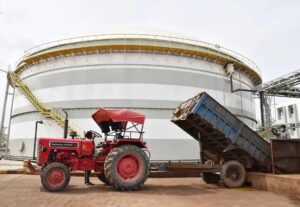
The purified gas can be used as fuel for cooking, fuel for industry, fuel for electricity generation, and fuel for cars running on CNG. On the other hand, the waste product that remains after the extraction of gas turns out to be organic manure rich in nutrients which can again be put back into use on the farms.
Japan’s expertise in waste management, clean energy technology, and engineering will come handy in India’s effort to enhance the efficiency of the biogas plants.
Benefits to the Farmers and Rural India
One of the most important benefits of such an initiative is that it will have a direct effect on rural areas. No longer will farmers see agricultural waste and cow dung as mere leftovers. They could be made profitable sources of earning money through systematic collection and supply to biogas plants.
Organic fertilizer production will lower the cost of farming and enrich the soil. Furthermore, there will be job opportunities in waste collection, running of the plant, transportation, maintenance, and fertilizers supply. It is expected that rural cooperatives would perform a crucial function here providing the involvement of the local population into owning and managing the initiatives.
In general, the initiative could help improve the village economy along with contributing to the sustainable development objectives of India.
Environmental Benefits
There are environmental benefits from the Biogas Initiative of India and Japan as well. With each ton of waste utilized through the process of generating biogas, there is no necessity to burn agricultural waste in open fields, which are the primary sources of air pollution in the northern parts of India during certain seasons.
In addition, replacing the traditional fuel by compressed biogas leads to the reduction of carbon dioxide emissions. Organic fertilizers minimize the amount of chemicals getting into rivers and enhance soil quality.
Moreover, more efficient utilization of organic waste decreases emissions of methane into the atmosphere, thereby reducing the impact on global warming.
Enhancing Cooperation Between India and Japan
Apart from renewable energy, the project underlines the increasing strategic cooperation between India and Japan in recent years. Indeed, for the last decade, the two countries have collaborated in fields such as high-speed railways, digital technologies, manufacturing, infrastructure, defense, and clean energy.
With this regard, the project of biogas creation is one more aspect of collaboration between India and Japan, where the technologies of the latter will be used for harnessing the agricultural potential of India in order to develop renewable energy.
Challenges
Though the project is rather promising, its realization will require great efforts. Indeed, the construction of 1,000 biogas plants in a country like India presupposes sufficient funds, constant supply of agricultural residues, qualified personnel, high standards of technology and involvement of local people.
It was proved before that maintenance, efficient functioning and the level of awareness of consumers were the major factors that helped to maintain biogas projects. Thus, close cooperation of various parties including government agencies, farmers, cooperatives, and private sector will be required for reaching the aims of the project.
Conclusion
India-Japan Biogas Initiative is undoubtedly a significant step forward towards renewable energy and sustainable rural development in India. By focusing on the setting up of 1,000 biogas plants by 2030, the partnership aims to convert agricultural wastes into energy, generate jobs, enhance energy security, encourage organic farming, and minimize environmental pollution.
It is not just about giving money to India; rather, it is about creating a long-lasting partnership through technology transfer and innovation. In case of success, the partnership could prove to be one of the best renewable energy programs ever in India.