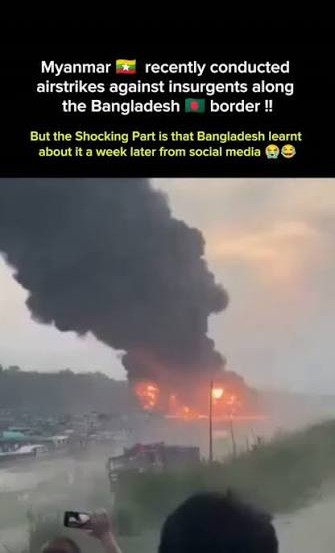
The Myanmar Armed Forces have once again stepped up their aerial attack on rebel groups that operate in the region near the border of Bangladesh. This is yet another escalation in the civil war which has been taking place in the country. The recent airstrikes were conducted in western Myanmar’s Rakhine State, mainly in the region of Maungdaw Township. This area has emerged as a primary battlefield for the military regime as well as the Arakan Army (AA).
Conflict Background
The country has been embroiled in conflicts ever since the military staged a coup in Myanmar in February 2021. This coup has led to widespread resistance in the entire nation with involvement of pro-democracy movements and some established ethnic armed groups. Some of these ethnic insurgent forces include the Arakan Army, an ethnic Rakhine insurgency which aims to gain more freedom for the Rakhine State.
In the last couple of years, the Arakan Army has taken control of most parts of the Rakhine State. As the army began to lose control of many key towns and borders, they began using air power against the insurgents rather than engaging in prolonged ground battles.
Recent Airstrikes around the Bangladesh Border
According to local sources, the Myanmar military has been conducting major airstrikes around Maungdaw and other neighboring places along the Bangladesh border. It is reported that fighter planes and military airplanes have conducted airstrikes using several bombs at spots which are thought to be controlled by insurgents.
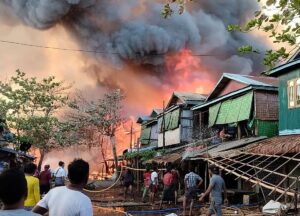
Strategic locations around Maungdaw, particularly those near the military stations and routes of transport, have been the targets of such an attack. According to eyewitnesses, there were several explosions at night time. The extent of the destruction and the number of casualties are yet to be confirmed.
However, without an official statement from the military about the operation, some analysts assume that the airstrike was intended to stop further advances of Arakan Army in northern part of Rakhine State.
Why the Border of Bangladesh is Strategically Significant
Myanmar-Bangladesh border extends over almost 270 kilometers and constitutes one of the most delicate borders in Southeast Asia. Large parts of this border share the vicinity of Rakhine State where Arakan Army has increased its reach considerably.
It is strategically significant because of many reasons; these include movement of supply chains, border security, movement of refugees, access by humanitarian organizations, and cross-border trade. Because of the presence of Arakan Army along this border at some points, Myanmar’s armed forces have sought to weaken their influence through constant air strikes.
For Bangladesh, the situation becomes problematic in terms of security because any kind of escalation can result in the flight of civilians to the border as well as violation of Bangladeshi soil.
Humanitarian Considerations
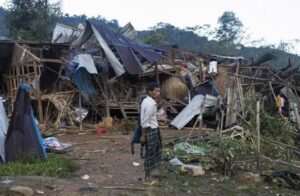
The most significant concern associated with such airstrike operations is their effect on civilians. The region of Rakhine State already consists of populations which have suffered years of violence and poverty.
Such bombing activities conducted in populated regions compel civilians to evacuate their homes without much notice. Some of the families move to the forest areas while others try to relocate near the Bangladesh border. Humanitarian agencies have been continuously warning that such airstrikes are worsening the problem of food shortage, lack of health facilities, and making assistance delivery more challenging.
Effects on Bangladesh
Despite the fact that military operations are being carried out within the borders of Myanmar, Bangladesh pays close attention to all developments that take place along the border.
In the past, conflicts in Rakhine have led to shells, stray bullets, and even mortar bombs falling into the Bangladeshi side, which has elicited diplomatic protests from Dhaka. Previously, Bangladesh had recalled Myanmar’s ambassador following cross-border firing during conflicts between the army and insurgents.
Bangladesh also fears yet another refugee crisis in addition to the one that is ongoing now. Currently, there are more than a million refugees in Bangladesh who came here fleeing violence in Myanmar.
Military Strategy Behind the Air Raids
It is suggested by military experts that due to the loss of control over some regions to resistance groups, the junta relies heavily on air power in their warfare. This is because by carrying out the airstrikes, the military can attack the positions of the insurgents without using many ground forces.
Nevertheless, this military strategy has been criticized heavily by several human rights groups worldwide due to the fact that the military raids tend to have an impact on civilians.
Reactions of Regional and International Players
The ongoing violence has led to increasing international worries. Some governments and aid agencies have raised concerns regarding the need for increased safety of civilians and diplomatic actions that would help decrease tensions.
The neighboring states are especially concerned since a long-lasting conflict near the international border poses a great threat of accidental breaches of international borders, movement of refugees and even instability of the region. Bangladesh has always been very attentive regarding this matter.
Conclusion
The recent airstrikes in Myanmar against insurgents near the Bangladesh border are yet another episode of the ongoing civil war in the country. While the military forces continue employing air strikes to combat the increasing influence of the Arakan Army, both the security and humanitarian challenges keep on increasing.
It is quite evident that the situation is still very volatile, especially in Rakhine State, where the civilians find themselves between the operations of the military forces and insurgents. The conflict, however, is not an internal problem for Bangladesh since the country shares a common border with Myanmar, in addition to dealing with the refugee crisis of Rohingya Muslims.